 |
| More reality than the leading costume drama |
Around 2009-ish, I was in a critique group with the late-great Roger Paulding. Roger was an excellent writing coach—well-read, true ear for multiple genres, no nonsense crits—and a damned-good writer.
Usually...
On this particular night, he decided to grace us with a chapter from a thriller in progress. I’ll spare you the play-by-play and cut straight to business.
The protagonist was an FBI agent recovering from surgery. So far, so good. Another FBI agent provided care, disguised as a nurse, either to provide close protection or surveillance of the protag. A little fuzzy but still functional.
The protag was a white male, stoic, focused, professional—the character you’ve seen in 80% of movies/books written. The agent/nurse was an African American woman and written to be a romantic interest for the protag.
I’ve been in a mixed-marriage for something-something years and seldom see depictions of couples like us, so this got my attention.
Then it got awful
Roger wrote Agent Nurse as teenage-smitten for the protagonist. Like 2500 words of internal dialogue about how attractive he is, how would her mother react if she only knew that Agent Nurse was attracted to a white man, (if not apparent, I'm editing heavily) and basically everything but "is that an erection or am I just excited by antiseptic and hospital corners?" He also liberally sprinkled-in slang and dialect for long-lasting offense.
When he finished reading, we all sat stunned. Normally the first to charge in amid a flurry blue-ink markups, I kept my yap shut. When the critiques finally started, the comments were “I liked your use of punctuation,” reticent. But Roger knew my relationship dynamic and wanted my feedback.
Then it got hostile
I began with the indisputable truth: he could write better than this. Agent Nurse was 2-dimensional and like a white guy's idea of how a black woman would speak. Once I started, I was unable to get my mouth back on the leash. I further said the logic did not track on any story level: dramatic, comedic, or pornographic. The depiction was, in fact, offensive in the way it wastes the readers’ time.
Afterwards, (as in after I was invited to leave) I realized that really, this is the way a lot of interracial relationships are written. If written at all, they are shoehorned in as gimmick or simply to shock. And then I filed the whole experience away, under “I,” for “I think it’s time to give this crit group a break.”
Last year, I found Onjuli Datta’s excellent essay, Writing the White Boyfriend. Datta succinctly summarizes the dawning of interracial romances as a subgenre. She then illustrates “the white boyfriend” as the author’s favorite novel trope for exploring the delight in differences.
Datta reminded me of the crit group and all the things I was too angry to articulate about Roger’s fu—mbled up chapter.
But I digress. Onjuli Datta’s essay is as thoughtful as it is brief. If I search to find a criticism, it’s just a little too polite but it’s not her fault.
This touchy business
In 1968, groundbreaking series, Star Trek, made history with the episode, Plato’s Stepchildren, which featured American television’s first interracial kiss between Captain Kirk and Lt. Uhura. To this day, William Shatner, (Captain Kirk) qualifies that his lips never touched Nichelle Nicols' lips. That’s how deep racism and racial injustice goes—a white, jewish actor from Canada STILL feels the need to specify that his lips never touched a black woman’s.
I’d like to say we advanced beyond these petty prejudices but the whole point of this piece is honesty and knowing better to write better.
Jean Rhys’ Wide Sargasso Sea, (published in 1967) is a prequel to Charlotte Brontë’s Jane Eyre, (published in 1847). WSS tells the story of Rochester’s first wife, Antoinette. Rochester’s creole wife. Who ends up sold into marriage, stolen from her island home, and locked in Rochester’s attic while he woos, the white-on-white-in-white governess, Jane. Somebody gotta die…
So, yeah, Antoinette, (Bertha in JE) ends up dead in a house fire that she, (allegedly) starts. Rochester claims she was mad. Personally, I think she was good and fed-up with Rochester and his moldy-ass house.
.jpeg) |
| Roger wasn't grown enough to write this relationship |
Either way, people weren’t ready then, (they’re barely ready now) for a white-man-woman-of-color romantic story. Films make the best record. In Boris Sagal’s film, The Omega Man, (1971) it’s Charlton Heston’s Neville. In the James Bond film Live and Let Die, (1973) it’s Gloria Hendry’s Carver. In Joss Whedon’s Serenity (2005) it’s Alan Tudyk’s Wash. But the result is the same—if it’s an interracial relationship one of them is gonna die.
 |
| They both live but...yikes he was creepy even then. |
The thing is, most of the examples I cite, (Serenity being the exception) do not represent healthy relationships or fully formed characters. Most were written by WHITE dudes and they don’t want real women. They want platforms for their message, or vessels for their fetish, or in the case of Bond, a trend of the moment with a reassuring splash of colonialism and misogyny.
Good fiction requires some honesty. That honesty requires a clear-eyed approach to characterizations—the good, the bad, and the embarrassing.
But there’s no ignoring what’s gone before
Centuries of prejudice and racial injustice is the single largest obstacle to writing a responsible depiction of interracial relationships. However it is not the writer’s job, (capability?) to redress history. The writer’s job is to tell a story, honestly and responsibly. Ideally, it should be entertaining, as well. None that is possible without an engaging, fully formed woman.
So, who does it right?
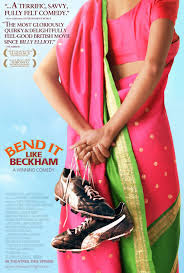 |
| Write her well—the rest falls in place |
In 2015’s Bend it Like Beckham, Jess (Parmender Nagra) LOVES football, which is denied to her by her strict Sikh family. She develops feelings for (white) football coach, Joe, (Jonathan Rhys Meyers) as you do. Jess has goals, fears, and hopes—all independent of Joe.
 |
| Sure, call her the "girlfriend," I dare you. |
In James S.A. Corey’s Leviathan Wakes, (and the television The Expanse) Naomi Nagata, has goals, (self-rule and full rights for her people) hopes, (an end of hostilities perpetuated by Earth and Mars) and fears, (that her past activities with a separatist group will be outed)—all before she ever meets James Holdin.
If not readily apparent, both women also have flaws. Rather than be honest with her parents, Jess sneaks around and lies, straining all of her relationships, (aka acts like a teen). As a former agent of a violent separatist group, Naomi has done much worse. Her subterfuge puts herself and her crew-mates in mortal danger.
Both women also have strengths. Jess is loyal to her friends, (covering for one who is gay) and family. She subverts what she wants for the sake of her sister's impending nuptials. And she matures enough to come clean with her family.
Naomi is also loyal to her friends—and not just to the tall, lanky, good-looking friends. She is sisterly to Amos, the psychopath, and to her former OPA mentor. She is brave and doesn't back down. Mostly, though, she is smart. A mechanic turned engineer, she keeps their ship in the air.
Write people, not characters—and certainly not stereotypes
Worry less about looks and more about content of character. Identify the person you want to write to yourself first. Instead of relying on sit-coms or even rom-coms for reference, write a bio. Of course, 90% of what you write about this woman will never be seen by the reader but it will help you zero-in on the person, their wants, needs, and fears. If you're successful, you will want to spend ten-or-so hours (the time it takes to read the average novel) with them and then write their part of the relationship, honest and relatable.
Side note: never, ever use food as a skin-tone descriptive. It's objectifying. Yeah, yeah, you have a friend who doesn't mind. Guess what, a lot more people do mind and they don't know you.
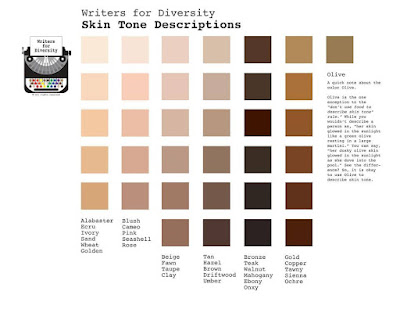 |
| Relevant, non-offensive skin-tone descriptions. |
Differences are to be celebrated
.jpeg) |
| If you believe it they will live it |
The person who says “I don’t see color,” or “color doesn’t matter to me” has the privilege of not being on the receiving end of prejudice with power. They’re also lazy and refuse to deal with their shit in the context of a larger world. Don’t be that writer. Embrace your person’s individuality, neither as gimmick nor gag but as an individual.
Nobody gets a “pass”
No racist-banter. No slang. And I don’t care how many Eddie Murphy movies, Chris Rock stand-up routines , or Quentin Tarantino artistic-license explanations you’ve seen—use racist invectives, in ANY context, at your own peril.
 |
| Who wouldn't want to live in their world— or write it? |
Write actual people talking, arguing, getting to know each other, getting rude with each other, and falling in love with each other.
In her article, Onjuli Datta refers to the honesty of writers, (almost all women) when crafting the white boyfriend, their flaws and characteristics. She also writes of the reversal, (that isn’t quite reversed) of the exoticism/fetishism from earlier books with white male leads falling for a beauty of another color/culture. Write vibrant. Write clear. Don’t backtrack.
Check out Onjuli Datta's article, here.
I own none of the images here. All are used for educational/instructional purposes, as covered by the Fair Use Doctrine.



.jpeg)


.jpeg)

.jpeg)
